Sunday, February 24, 2008

So how do you like your eggs?


I thought of that old joke, y'know, the, this... this guy goes to a psychiatrist
and says, "Doc, uh, my brother's crazy; he thinks he's a chicken." And, uh, the
doctor says, "Well, why don't you turn him in?" The guy says, "I would, but I
need the eggs." Well, I guess that's pretty much now how I feel about
relationships; y'know, they're totally irrational, and crazy, and absurd, and...
but, uh, I guess we keep goin' through it because, uh, most of us... need the
eggs.


These are the parting thoughts from Alvy Singer, the main character in Woody Allen’s Annie Hall. Alvy is a New York comedian who falls in love with a girl named Annie Hall. The movie works as a narrative to all of Alvy’s relationships and his feelings towards love in general. If the quote above is any indication, he’s witty, funny, but a bit of a pessimist.

After having not really enjoyed watching Allen in Mighty Aphrodite, I must concede that I now can understand how great an actor he truly was/is. Annie Hall won best picture at the Oscars in 1977 (note: this is a Woody Allen about 20 years younger than his character in Mighty Aphrodite) and it’s easy to see why when you have such believable characters. Allen knows what kind of characters he is and he casts himself perfectly in Annie Hall (short, angry, witty, and Jewish).

But the thing that’s best about Annie Hall is how Allen depicts modern relationships and the crazy, memorable events we take out of them. The film ends with a montage of all the greatest scenes from Alvy and Annie’s life together. We see the first time the met at the tennis court, we see them struggle to make lobster for dinner after the lobsters break out of the bag, we see them try cocaine (which Alvy sneezes everywhere), and many other memories. Allen makes a valid point that relationships are irrational, crazy, and absurd, but he forgets that they’re also exciting, adventurous, and happy. And that’s why we need the eggs.

Tuesday, February 19, 2008

Mighty Aprhodite


Where in science is human intelligence connected with family genes? Lenny, the father of a brilliant adopted son Max, is out on a search for his assumed ‘brilliant’ mother. Lenny meets the mother finding that she is a not so bright prostate. Now I don’t mean to be awful and say this for all adopted children, but, if the parents were genesis just like Max wouldn’t you think that such brilliant parents wouldn’t put their child up for adoption. And now that I look into this topic, it says on a couple adoption information websites that most children who are put up for adoption come from a troubled and/or unplanned parent/s. So what I am wondering is… Was Lenny really expecting to find these brilliant parents at the other end of the rope? Because I know how much we all like the saying the apple doesn’t fall far from the tree but that doesn’t mean the tree isn’t sitting on a hill and the apple did fall near the tree and thus rolled far down the hill away from that tree.
Though this movie is quiet uplifting and I would agree that Woody Allen made this subject very interesting on many levels. The character choice is much in my favor. Generally Woody Allen hires his characters to be played by people who can become or are that part, that he isn’t just hiring another actor/ actress. I believe movies are much more enjoyable when characters are

cast by talent rather then by name.

-Jennifer

Monday, February 18, 2008

Now I ain't sayin' she's a golddigger, but that dude's really old!


Sex sells. Romance is what drives many of our favorite movies and TV shows. It’s the story that every writer and director can turn to because we the viewers like to see our own romantic troubles mirrored on the silver screen. Mighty Aphrodite (1995), directed by Woody Allen, is a film about a New York sportswriter, Lenny, and his search for the birth parents of his adopted son Max. But the movie takes a dramatic turn when we learn that Max’s birth mom is a prostitute/porn star (whose lack of intelligence begs the question why is Max so brilliant?).
Up to this point I think anybody can see the comedy in this film and find it humorous, but the drawback that makes this movie a pinch too disgusting for my taste is that the leading actor is PLAYED BY Woody Allen himself. The film introduces the viewer to a romance between the 60-something year old Woody Allen and the less-than-half-that age Mira Sorvino. Perhaps what makes this more distasteful is that any informed viewer can see how Allen might have thought up this storyline from his own life and the publicized relationship he had with his “stepdaughter”. Even without the back story, these types of relationships are not things people pay to see at the movies. Kenneth Turan sums this up in his review perfectly saying,


And though Allen's fascination with older men/younger women relationships has
yielded successes like "Manhattan" and "Husbands and Wives," the older he gets
the more uncomfortable these liaisons are to watch. And throwing in the
venerable male fantasy of getting involved with an attractive prostitute adds to
the off-putting taste that not even a finely tuned sense of humor can totally
erase.


Woody Allen straddles a fine line in this movie and unfortunately the film is slightly more vulgar than it is funny.

Tuesday, December 18, 2007

Do the BETTER Thing


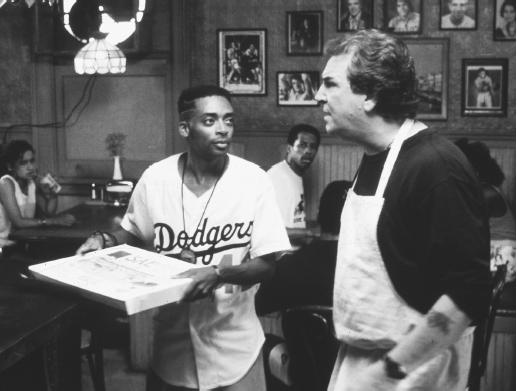
Did Mookie do the right thing? I think everybody wants there to be a definite answer, yes or no, but these types of situations are not black and white. Like so many things in life, the right thing is a shade of gray and ultimately no answer will be satisfying (otherwise why would people still be arguing over this?). But I feel Mookie did the better thing by throwing the garbage can through Sal’s window, not because he needed to take revenge on Radio Raheem, but rather it prevented a dangerous situation from taking more lives. I proposed this idea in class, and was relatively shot down, but considering nobody else has come up with anything that provides REAL closure I’ll stick with my own observations.


Spike Lee was quick to point out on his DVD that critics cared more about the loss of white property than the death of Radio Raheem. This is wrong and there’s no way to argue that. However, in developing my theory, I think it’s also important to note that Radio Raheem nearly killed Sal, but nobody really cares about that either. If Radio Raheem was not killed by the cops, he still was going to be put in jail. Point being he was not coming back (this doesn’t condone him being killed though). After Radio Raheem died and the cops departed, they left a red hot crime scene where Sal and his two white sons were surrounded by an entire grief-stricken black neighborhood. They had nobody to protect them. Just the three of them (cornered against the pizzeria) versus an entire community.


What followed was Mookie threw the garbage can through Sal’s window and the riot broke out. Nobody can tell for certain WHAT WOULD HAVE happened had he not done that, but I don’t think many people believe Sal or his pizzeria could have escaped untouched. By throwing the garbage can through the window, Mookie diverted attention from Sal to the pizzeria and everybody was able to vent their pain on inanimate objects. Sal and his boys were allowed to walk away untouched (although they were still banged up from the fight before) and watched their home burn down from across the street. Was Mookie right to throw the garbage can through the window? I think the loss of Sal’s pizzeria is better than the loss of Sal’s life/health. Only one person died in that entire scene (Radio Raheem). Had Mookie not thrown the garbage can, that number very well could have been a lot higher.

Obviously there are holes in this argument. As I said in the beginning, nothing is black and white. Some things after the riot scene may contradict the theory, but hopefully it allowed you an alternative way of interpreting the end of the movie.

Tuesday, December 11, 2007

Remember Us, as simple an order as a King could give, Remember Us


“The Battle of Algiers” has no main character, for the most part it takes no sides, and if it were not for Iraq and other threats of terrorism, the movie would probably not be the least bit relevant in the modern world. I think these things to some extent detract from one’s ability to watch this purely as a movie and try to enjoy it. Fortunately for us, “The Battle of Algiers” quite simply puts the “art” in Art of Film.

I did not have a good time while watching this film because I did not understand it. At the time it was difficult for me to grasp how this could be a movie and not have a main character or tell a war story and not pick a side. I think it takes one complete viewing to understand “The Battle of Algiers”. The artistry comes in the film’s ability to depict a conflict and stay neutral over it. There are characters, but the viewer is not forced to connect with any of them. The two sides are the French and the FLN and the viewer gets to see both their virtue and their corruption. As Ann Hornaday from the Washington Post describes,


The greatness of "The Battle of Algiers" lies in its ability to embrace moral
ambiguity without succumbing to it. And although Pontecorvo has been rightfully
lionized for the realism of the film, its visual artistry -- the carefully
composed shots, their gestural grace, their unerring temporal and spatial logic
-- is as potent as anything by Goya.


Pontecorvo didn’t make “The Battle of Algiers” for the enjoyment of the viewers. It wasn’t made to thrill, to scare, to sell tickets, nor to win awards. I think it was made to show you what happened to the Algerian people. But the movie won’t force-feed you any lessons or themes. It simply shows history as non-biased as possible. And that is incredibly difficult to do. That alone is art. I think all this film asks is that you don’t forget it.

Wednesday, November 28, 2007

Film Noir Goes To Men's Wearhouse


Suits. The underground universal characteristic of film noir? If Out of the Past, Kiss Me Deadly, and Chinatown are any indication, men’s formal wear may just be one of the most telling characteristics that make a film noir.

In all three of the film noir’s we watched in class, probably around 80% of the men were in suits. Now given that most of the stories are about detectives, this makes sense that the protagonist would sport a trench coat and the villains would be outfitted just as classy. But when you give some thought to it, what other film genre can make the claim that most of its characters wear suits? Perhaps spy movies, but really aren’t these just a modernized extension of the detective story line?

Chinatown was no exception to the suit rule; in fact, Jack Nicholson’s character’s attire inspired me to restart my search for a white suit. A few people in class mentioned that since Chinatown was in color it made it less of a film noir. But one of the bonuses of color highlights a different feature of film noir: Jack Nicholson’s suits. I counted at least four different colors throughout the course of the movie. Coupled with the fact that Jack Nicholson is a sexy beast, this movie certainly would have lost a lot if it wasn’t in color. Nicholson and the supporting cast are decked out in suits for nearly the entire movie.

So, in honor of Jeff Foxworthy, “If the movie yer watchin gots dudes in suits in it, it might just be a film noir.”

Monday, November 19, 2007

Would you like to comment?

I’m up for avoiding work as much as the next guy, and I’m sorry to all of you people who would read this if you were still forced to, but I feel compelled to ask if anybody else is actually reading these things now that comments are no longer required. I was always motivated to try at these assignments knowing that other people may actually read them. However, without user feedback I have a sinking feeling that my posts are going to deviate farther and farther away from their usual “quality”.

So I would ask of anybody who is still reading this to comment on this post (just one!). If you don’t, then I suggest you STOP reading this because things are about to get really, really stupid (just kidding Klobs).